
A wired four camera 4K system on a single storey home starts at $1,690 installed, and most houses on the northside end up under $2,600. Here is what you get for that, and how to read a quote that looks too cheap.
Many installers leave prices off their sites and give a figure only after a visit. We would rather show them, explain what changes them and let you compare any quote you get, ours included.
Installing cameras you have already bought starts at $490. That covers one standard wired camera on a single storey home with ceiling access, including heavy duty Cat6, terminating both ends, connecting it to your recorder and setting up the app. The hardware itself is yours, and its warranty comes from the shop.
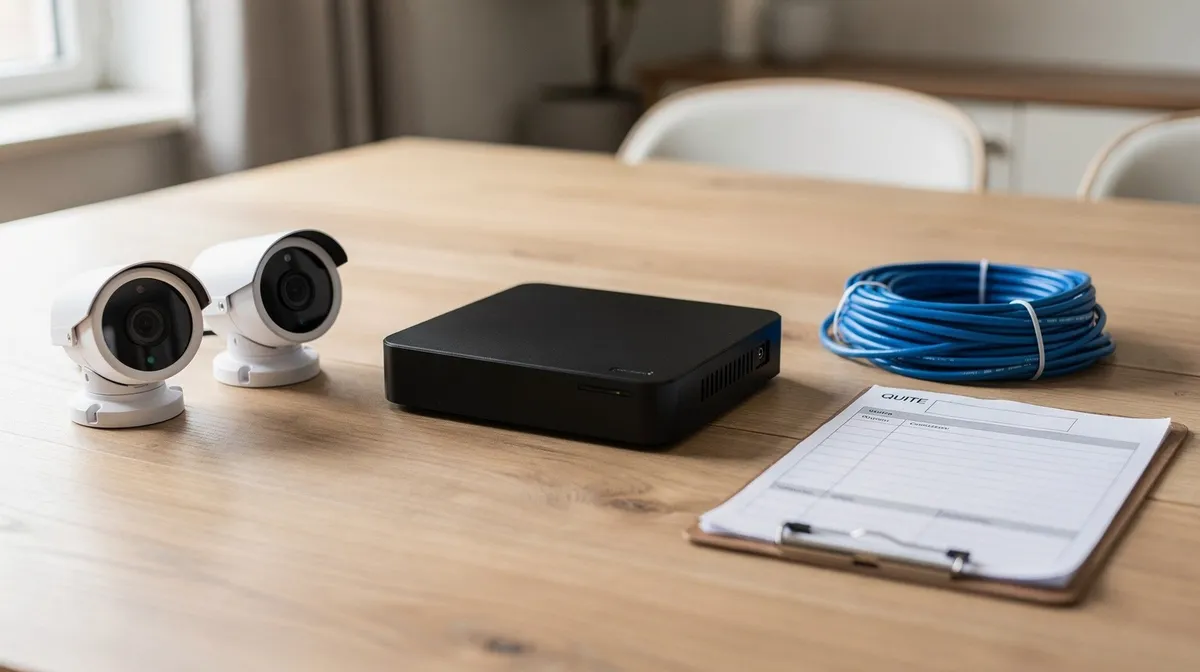
A complete four camera 4K wired system starts at $1,690 fitted. You get four weatherproof turret cameras, a 4K network recorder with a surveillance grade drive, Cat6 run inside the ceiling to every camera, and the app on the household’s phones. Hardware is covered for three years and our workmanship for five.
The active deterrence system starts at $1,890. The installation is identical, but each camera adds a siren, strobe lights, colour night vision and two way audio, along with detection that separates people and vehicles from animals. It uses an eight channel recorder, so four channels are free for later.
Hardware prices stay fairly fixed. Labour is what moves, and it depends mostly on how hard the cable is to run.
On the northside, the common extras are two storey homes, which add ladder work and sometimes a second person, and flat roofed extensions or patios with no ceiling space, where cable has to run in a slim external channel. Townhouses can need body corporate approval and careful routing around firewalls. Long driveways and detached sheds or granny flats add cable length and sometimes trenching.
Extra cameras add cost, though not evenly: six cameras usually cost about a third more than four. Keeping thirty days of 4K footage instead of a week needs a much larger drive. Old coax can sometimes be reused for HD analogue cameras, but we test it first.
When one quote is far below the rest, something has usually been left out.
Cable outside. Running cable along the gutter and down the bricks is quick. It also fades, cracks and can be cut by anyone who wants the cameras off.
A small drive. Everything works on day one, but the system writes over itself after a few days, which is too short for most incidents.
Low recording quality. Many kits save 4K at such a low bitrate that the detail is lost.
No licence. Queensland requires a security equipment installer licence for the installation and ACMA cabling registration for the cable work. Richard holds QLD Security Provider Licence 4930731, and his ACMA cabling registration number is A058225.
Cameras nobody set up. Mounted at the same height everywhere and never checked at night, they record plenty but identify nobody. Our guide to how many cameras you need covers placement.
Very low. The cameras draw power through their network cable, and a whole system uses about the same as a couple of light globes. Footage is stored on the drive in your home, so there are no monthly fees.
The drive is the part that wears out, usually after three to six years of constant recording. Replacing it costs little and takes about twenty minutes.
For most households, a system costs less than an insurance excess or two. People also end up using it for small things, like checking a delivery arrived, seeing who knocked or finding out who clipped the car parked out the front.
When comparing quotes, ask each installer for the camera model, cable type and route, drive size and licence numbers, and put them side by side.
No. Quotes are free, in writing and itemised, listing each camera position, the equipment and where the cable will run.
The difference is nearly always in the cable and the hardware. Ask both for the cable type and route, the drive size, the camera model and their licence numbers, then compare like with like.
Somewhat. Higher ladder work and longer cable runs add time, and some second storey positions need two people.
Yes. We suggest an eight channel recorder even on a four camera job, which makes extra cameras later a simple add on.
The positions that matter most, when a fifth or sixth camera makes sense and how lens choice changes things.
Buying adviceHow wired, wifi and battery cameras differ, and where each one suits.
QueenslandThe rules for homes, complexes, rentals and businesses, in plain words. Not legal advice.
HiringWhich licences to check, what to ask and the warning signs to look for in a quote.
BrandsHow the three brands differ on night vision, detection, deterrence and apps, and what matters more than the logo.
Wired 4K cameras for northside houses, with the cable hidden and the app set up on your phone.
BusinessCameras for shops, clinics, offices and workshops, planned around doors, counters and car parks.
RepairsFault finding for dead cameras, full drives and broken apps, and upgrades from old analogue gear.
DeterrenceCameras with strobes, a siren and smart detection that warn people off before they reach the door.
Cameras and cabling in Chermside 4032.
4032Cameras and cabling in Chermside West 4032.
4034Cameras and cabling in Geebung 4034.
4053Cameras and cabling in McDowall 4053.
4012Cameras and cabling in Wavell Heights 4012.
4034Cameras and cabling in Zillmere 4034.
Tell us a little about the property and we will reply with a written quote that lists every item.
Thanks. Richard (QLD Lic #4930731, ACMA #A058225) now has your details and will check over the job and reply with a written, itemised price within 15 to 30 minutes during trade hours.